


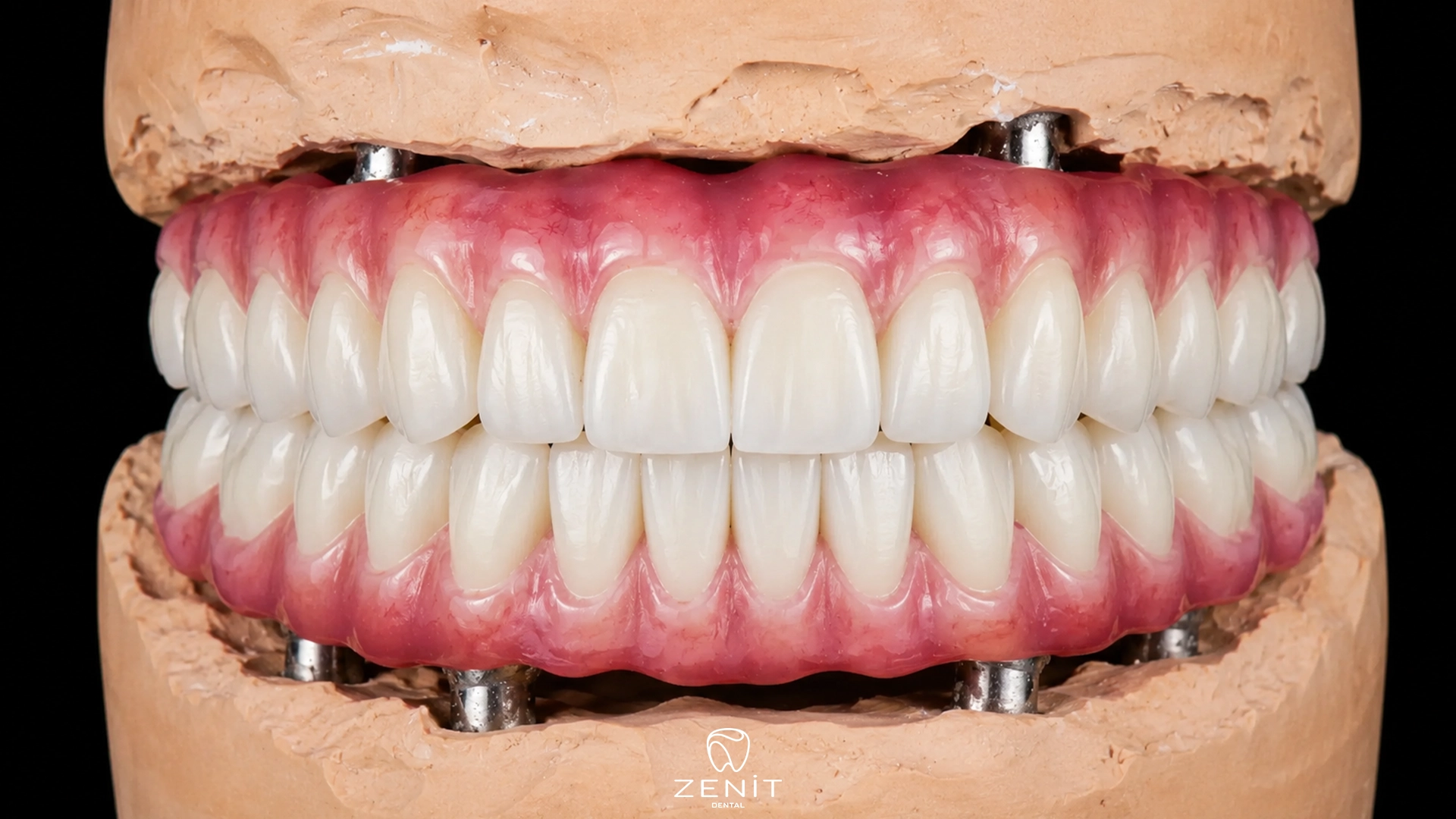
What Is an Implant-Supported Prosthesis? Differences Between Fixed and Removable Prostheses
Tooth loss is not merely a problem that affects aesthetic appearance. Missing teeth can lead to impaired chewing function, difficulty pronouncing certain sounds correctly, gradual shifting of surrounding teeth, and a decrease in overall quality of life. Today, one of the most advanced methods used to treat missing teeth is implant-supported prosthetic treatment.
Especially in patients with multiple missing teeth or complete tooth loss, implant-supported prosthesis options can provide stronger retention and greater comfort compared with conventional dentures. Since dental implants are placed into the jawbone, the prosthesis can remain more stable inside the mouth.
However, the same type of prosthesis is not suitable for every patient undergoing implant treatment. Depending on the treatment plan, fixed or removable implant-supported prostheses may be recommended. At this point, some of the most frequently asked questions include “What is an implant-supported prosthesis?”, “Is a fixed implant prosthesis better?” and “Who is suitable for a removable implant prosthesis?”
In this article, Zenit Dental explains what implant-supported prosthesis treatments are, the different types available, the main differences between fixed and removable prostheses, and the key points patients should consider during treatment.
What Is an Implant-Supported Prosthesis?
An implant-supported prosthesis is a prosthetic restoration that is supported by dental implants placed into the jawbone. Dental implants are generally made of titanium or similar biocompatible materials and are designed to function as artificial tooth roots.
After an implant is placed into the jawbone, a biological integration process occurs between the implant and the surrounding bone. Once this process is completed, different types of prostheses can be placed on the implants according to the patient’s needs.
These prostheses may include:
- An implant-supported crown for a single missing tooth,
- An implant-supported bridge for multiple missing teeth,
- A fixed implant-supported prosthesis for complete tooth loss,
- A removable prosthesis supported by dental implants.
Therefore, an implant-supported prosthesis does not refer to a single treatment method. Instead, it is a general term for different types of prosthetic restorations that receive support from dental implants.
Why Is an Implant-Supported Prosthesis Preferred?
There are several options for replacing missing teeth, including conventional bridges and removable dentures. However, implant treatment may allow missing teeth to be replaced without altering adjacent healthy teeth in suitable patients.
For example, when a conventional dental bridge is used to replace a single missing tooth, the healthy teeth next to the gap may need to be reduced. With implant treatment, however, an implant can be placed directly into the missing tooth area, allowing an independent restoration to be created.
The main reasons why implant-supported prosthesis treatment may be preferred include:
- Providing an appearance close to natural teeth,
- Supporting chewing function,
- Offering greater stability inside the mouth,
- Reducing the risk of prosthesis movement while speaking,
- Helping preserve adjacent healthy teeth,
- Improving denture retention in fully edentulous patients,
- Supporting greater comfort in daily life.
However, implant treatment is not suitable for every patient. Jawbone structure, general health, oral hygiene, and certain systemic conditions should all be evaluated during treatment planning.
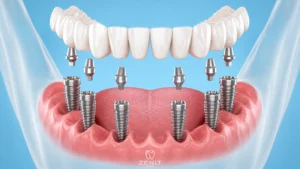
What Are the Types of Implant-Supported Prostheses?
Implant-supported prostheses are generally divided into two main groups:
- Fixed implant-supported prostheses
- Removable implant-supported prostheses
Both options are supported by dental implants. However, there are important differences in terms of how the prosthesis is used, how it is cleaned, and whether the patient can remove it.
When determining the most appropriate treatment method, the patient’s oral structure, number of implants, bone volume, aesthetic expectations, and oral hygiene habits are taken into consideration.
What Is a Fixed Implant-Supported Prosthesis?
A fixed implant-supported prosthesis is a type of restoration that is screwed or secured onto dental implants using special attachment systems and cannot normally be removed by the patient.
These systems can be used as a single implant crown, an implant-supported bridge, or a full-arch fixed prosthesis.
Fixed prostheses are used in a way that is similar to natural teeth. The patient does not remove the prosthesis. If necessary, it can be removed by a dentist.
Fixed prosthetic options may be considered especially for patients with a sufficient number of dental implants.
What Are the Advantages of a Fixed Implant-Supported Prosthesis?
One of the main advantages of fixed implant prostheses is that they can provide a sensation that closely resembles natural teeth.
Their primary advantages include:
- High stability inside the mouth,
- Minimal movement during chewing,
- Natural-looking aesthetic results,
- No need for the patient to remove the prosthesis,
- Greater comfort while speaking,
- A more natural tooth-like feeling.
However, cleaning fixed prostheses is extremely important. If plaque and bacteria around the implants are not adequately removed, problems may develop in the tissues surrounding the implants over time.
What Is a Removable Implant-Supported Prosthesis?
A removable implant-supported prosthesis is a prosthetic system that receives support from dental implants but can be removed and reinserted by the patient.
These prostheses are particularly suitable for patients who have lost all of their teeth.
In conventional complete dentures, retention largely depends on the gums and the structure of the jawbone. However, in some patients, bone loss can cause the denture to become unstable.
In such cases, implants placed into the jawbone can help the prosthesis remain more securely in place.
Various attachment systems placed on the implants allow the prosthesis to remain stable inside the mouth while still allowing the patient to remove it when necessary.
What Are the Advantages of a Removable Implant-Supported Prosthesis?
Removable implant-supported prostheses can offer important advantages, particularly for patients with extensive tooth loss.
These advantages may include:
- Greater retention compared with conventional complete dentures,
- Reduced risk of movement while speaking,
- Improved chewing function,
- The ability to remove the prosthesis for cleaning,
- The possibility of treatment with fewer implants in certain cases,
- Improved stability, particularly in lower-jaw dentures.
Removable prostheses should be taken out and cleaned regularly. In addition, the tissues around the implants should be cleaned using special brushes or other oral care products recommended by the dentist.
Differences Between Fixed and Removable Implant-Supported Prostheses
The most important difference between fixed and removable implant prostheses is whether the patient can remove the prosthesis.
Fixed prostheses remain attached to the implants inside the mouth, while removable prostheses can be taken out by the patient.
Method of Use
A fixed implant-supported prosthesis remains permanently inside the mouth and functions similarly to natural teeth.
A removable implant prosthesis is attached to the implants using specific attachment systems, but the patient can remove it for cleaning.
Number of Implants
Fixed prostheses may generally require greater implant support.
In some cases, removable prostheses can provide sufficient retention using fewer implants.
However, the number of implants required is not the same for every patient. Jawbone structure and prosthesis design are important determining factors.
Cleaning
Removable prostheses can be taken out and cleaned outside the mouth.
Fixed prostheses, however, must be cleaned while they remain in place. Special dental floss, interdental brushes, or oral irrigators may be used to clean the spaces around the implants.
Comfort
For many patients, fixed prostheses can provide a sensation that is closer to natural teeth.
Removable implant prostheses can be significantly more stable than conventional complete dentures, but they must still be removed regularly for cleaning.
Cost
Fixed implant prostheses may involve different costs because they can require a greater number of implants and more complex prosthetic work.
However, the total treatment cost varies depending on the number of implants, prosthetic material, jawbone structure, and any additional surgical procedures.
For this reason, an exact treatment cost can only be determined after a detailed examination and treatment planning.
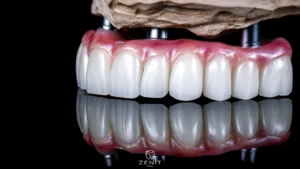
Who Is Suitable for a Fixed Implant-Supported Prosthesis?
Fixed implant-supported prosthesis treatment may be considered for:
- Patients with one or more missing teeth,
- Patients with complete tooth loss,
- Individuals with sufficient jawbone volume,
- Patients without general health conditions that prevent implant treatment,
- Individuals who are able to maintain regular oral hygiene.
However, implant treatment may not be suitable for everyone.
Conditions such as uncontrolled diabetes, advanced bone loss, certain systemic diseases, or inadequate oral hygiene may require further evaluation.
For this reason, a detailed clinical and radiographic examination is important before implant treatment.
Who Is Suitable for a Removable Implant Prosthesis?
Removable implant-supported prostheses are commonly used, especially in patients who have lost all of their teeth.
Patients who have difficulty using conventional dentures or whose dentures move while eating or speaking may benefit from removable implant-supported prostheses.
In particular, conventional complete dentures in the lower jaw may have limited retention in some patients. Implant-supported systems can help improve denture stability.
How Is Implant-Supported Prosthesis Treatment Performed?
Implant-supported prosthesis treatment generally involves several stages.
1. Examination and Planning
The first stage involves evaluating the patient’s oral and dental structure.
If necessary, panoramic X-rays or three-dimensional imaging techniques may be used.
The thickness and height of the jawbone, as well as the planned implant locations, are carefully analyzed.
2. Placement of the Implants
According to the treatment plan, implants are placed into the jawbone.
The procedure can usually be performed under local anesthesia.
3. Healing Period
A certain healing period is required for the implants to integrate with the surrounding bone.
The duration of this process may vary depending on the patient’s bone structure and the area being treated.
4. Taking Impressions
Once healing is complete, the prosthetic phase begins.
An impression is taken according to the position of the implants, and laboratory procedures are started.
5. Preparation of the Prosthesis
The prosthesis is designed by considering the patient’s tooth color, facial structure, jaw relationship, and aesthetic expectations.
6. Placement of the Prosthesis
The completed prosthesis is attached to the implants and the bite relationship is checked.
The patient is then informed about how to use and clean the prosthesis.
What Materials Are Used in Implant-Supported Prostheses?
Different materials can be used in implant prostheses.
The most commonly used materials include:
- Zirconia,
- Porcelain,
- Metal-supported porcelain,
- Hybrid prosthetic materials,
- Acrylic-based prostheses.
The most suitable material is selected according to whether the prosthesis is fixed or removable, the number of implants, the aesthetic zone, and the patient’s oral structure.
Different materials may be preferred in the front tooth region where aesthetic expectations are generally higher.
How Long Does an Implant-Supported Prosthesis Last?
It is not possible to define the lifespan of an implant-supported prosthesis with a single fixed number.
The long-term health and durability of implants and prostheses depend on several factors, including:
- Oral hygiene,
- Regular dental check-ups,
- Smoking habits,
- Teeth grinding or clenching,
- Proper distribution of chewing forces,
- The health of the tissues surrounding the implants.
Good oral care and regular professional check-ups can help implant-supported prostheses remain functional for many years.
How Should an Implant-Supported Prosthesis Be Cleaned?
Plaque can accumulate around implants just as it can around natural teeth.
For this reason, proper cleaning of implant prostheses should never be neglected.
In addition to a toothbrush, the following products may be recommended for fixed prostheses:
- Interdental brushes,
- Implant-compatible dental floss,
- Bridge floss or floss threaders,
- Oral irrigators.
Removable prostheses should be taken out of the mouth and cleaned separately. The tissues surrounding the implants should also be brushed carefully.
The dentist can provide personalized oral hygiene recommendations based on the type of prosthesis used.
Why Are Regular Check-Ups Important for Implant-Supported Prostheses?
Implant treatment should not be considered completely finished once the prosthesis has been placed.
Regular monitoring of both the implants and the prosthesis is important.
During routine examinations, the dentist may evaluate:
- Gum health around the implants,
- Prosthetic connections,
- Screw loosening,
- Chewing forces,
- Prosthetic surfaces,
- Oral hygiene.
Problems detected at an early stage can generally be managed more effectively.
Is a Fixed Implant Prosthesis Better Than a Removable Implant Prosthesis?
There is no single answer that applies to every patient.
A fixed implant-supported prosthesis can provide a more natural tooth-like experience. However, it requires suitable bone structure, an adequate number of implants, and good oral hygiene.
Removable implant prostheses can be highly functional, particularly for fully edentulous patients and for individuals whose conventional dentures do not provide sufficient retention.
The appropriate prosthesis should be selected by considering:
- Jawbone volume,
- Number of implants,
- Patient’s age,
- General health condition,
- Aesthetic expectations,
- Oral hygiene habits,
- Budget,
- Chewing forces.
Therefore, it would not be correct to make a general statement such as “fixed prostheses are always better” or “removable prostheses are always more advantageous.”
What Should Be Considered After Implant-Supported Prosthesis Treatment?
Regular care is necessary after treatment in order to protect both the implants and the prosthesis.
Patients are generally advised to:
- Brush their teeth regularly,
- Clean around the implants carefully,
- Attend routine dental examinations,
- Be cautious when consuming very hard foods,
- Inform their dentist if they grind or clench their teeth,
- Schedule a dental appointment if they notice movement or damage in the prosthesis.
If loosening is noticed in the prosthesis, patients should avoid continuing to place pressure on it and should consult their dentist.
Does an Implant-Supported Prosthesis Look Natural?
Thanks to modern digital dentistry techniques and advanced prosthetic materials, highly natural-looking restorations can be created.
The following characteristics can be planned according to the patient’s facial structure:
- Tooth color,
- Tooth size,
- Tooth shape,
- Tooth alignment.
Especially in aesthetic areas, gum harmony and smile design play an important role in implant-supported prosthesis treatment.
However, the final result may vary depending on the patient’s existing bone and gum structure.
Does an Implant-Supported Prosthesis Cause Pain?
Significant pain is generally not expected during the prosthetic phase.
However, after the surgical placement of dental implants, mild pain, sensitivity, or swelling may occur for several days.
The intensity of these symptoms can vary depending on the extent of the procedure.
If persistent pain, swelling around the implants, bleeding, or noticeable movement in the prosthesis occurs, a dental examination is recommended.
Frequently Asked Questions About Implant-Supported Prostheses
Can an implant-supported prosthesis be removed?
Fixed implant prostheses cannot normally be removed by the patient. They can be removed by a dentist when necessary.
Removable implant prostheses, however, can be removed and reinserted by the patient.
How many implants are needed for an implant-supported prosthesis?
The number of implants required varies according to the patient’s jaw structure, bone volume, and the type of prosthetic system being used.
Therefore, there is no standard number of implants that applies to every patient.
Can an implant-supported prosthesis be used like natural teeth?
Fixed implant prostheses can provide a chewing and speaking experience that is quite similar to natural teeth.
However, oral hygiene around implants may differ from the care required for natural teeth.
Does an implant prosthesis move?
Noticeable movement is not expected in a properly planned fixed prosthesis.
In removable implant-supported prostheses, attachment systems help improve the stability of the prosthesis.
How is an implant prosthesis cleaned?
Fixed prostheses are cleaned inside the mouth, whereas removable prostheses are taken out for cleaning. In both cases, special attention should be paid to the hygiene of the tissues surrounding the implants.
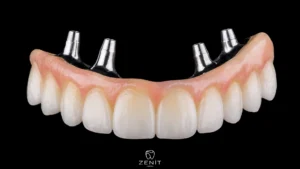
Implant-Supported Prosthesis Planning at Zenit Dental
Successful implant treatment does not depend only on placing implants into the jawbone. Proper prosthetic design, correct implant positioning, and the development of a treatment plan that is suitable for the patient’s oral structure are also extremely important.
At Zenit Dental, implant-supported prosthesis treatments are planned by evaluating the patient’s jawbone structure, existing teeth, gum health, aesthetic expectations, and chewing function together.
Whether a fixed or removable prosthesis is more suitable can be determined after a detailed clinical examination.
Conclusion: Is a More Comfortable Smile Possible with an Implant-Supported Prosthesis?
Today, implant-supported prosthesis treatments have become one of the most important options for replacing missing teeth.
Implant-supported prostheses can be used in a wide range of cases, from a single missing tooth to completely edentulous jaws.
Fixed implant prostheses can provide a tooth-like experience, while removable implant prostheses can significantly improve denture retention, especially in patients with complete tooth loss.
When deciding which treatment is most suitable, aesthetic expectations are not the only factor to consider. Jawbone structure, the number of implants, oral hygiene, and the patient’s general health should also be evaluated.
For this reason, implant-supported prosthesis treatment should always be planned individually.
If you have missing teeth and would like to learn more about fixed or removable implant-supported prosthesis options, a detailed examination at Zenit Dental can help determine the treatment alternatives that are most suitable for you.