



How Many Sessions Does Root Canal Treatment Take? How Does the Root Canal Treatment Process Work?
Toothache, sensitivity to hot and cold, discomfort while chewing, or infections developing around the tooth root may make root canal treatment necessary. One of the most common questions patients ask before undergoing treatment is: how many sessions does root canal treatment take?
The duration of root canal treatment is not the same for every patient. The structure of the tooth, the severity of the infection, the number of root canals, whether the tooth has been treated before, and the anatomical characteristics of the roots can all directly affect the number of sessions required.
While root canal treatment can sometimes be completed in a single session, two or more appointments may be necessary when the infection is advanced or the root canal anatomy is more complex.
In this guide prepared by ZenitDent, we explain in detail how many sessions does root canal treatment take, how the root canal treatment process works, the stages involved, and what patients should pay attention to after treatment.
What Is Root Canal Treatment?
Root canal treatment is a dental procedure performed when the living tissue inside the tooth, known as the dental pulp, becomes damaged due to infection, trauma, or advanced tooth decay.
The dental pulp consists of nerves, blood vessels, and connective tissue. Deep cavities or cracks in the tooth may allow bacteria to reach this area, potentially causing inflammation or infection of the pulp.
The primary purpose of root canal treatment is to remove infected or damaged tissue, disinfect the root canals, and seal them with appropriate filling materials.
A successful root canal treatment may help preserve the natural tooth and allow it to continue functioning without the need for extraction.
How Many Sessions Does Root Canal Treatment Take?
One of the most frequently asked questions before treatment is how many sessions does root canal treatment take?
Root canal treatment can generally be completed in one or two sessions. However, some complex cases may require additional appointments.
If there is no severe infection, the root canals can be cleaned effectively, and no complications occur during the procedure, the treatment may be completed in a single session.
However, if there is an infection at the tip of the root, an abscess, significant inflammation, or complex root canal anatomy, the dentist may need to place medication inside the canals and complete the treatment at a later appointment.
Therefore, rather than giving a fixed answer to how many sessions does root canal treatment take, the condition of the individual tooth should first be evaluated.
Can Root Canal Treatment Be Completed in One Session?
Yes. In suitable cases, root canal treatment can be completed in a single appointment.
Modern endodontic technologies, rotary instruments, electronic apex locators, and advanced imaging techniques have made it possible to complete many root canal procedures in one session.
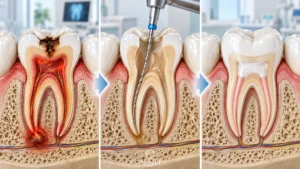
A single-session root canal treatment generally includes the following steps:
- The tooth is numbed with local anesthesia.
- Decayed and infected tissues are removed.
- Access to the root canals is created.
- Infected pulp tissue inside the canals is removed.
- The canals are shaped using specialized instruments.
- The canals are disinfected.
- The root canals are filled with a suitable filling material.
- The tooth is sealed with a temporary or permanent restoration.
However, depending on the condition of the tooth, treatment may require two or more sessions.
Why Can Root Canal Treatment Require More Than One Session?
One of the most important factors affecting how many sessions does root canal treatment take is the severity of the infection.
In cavities that have remained untreated for a long time, bacteria may spread beyond the pulp and reach the tissues surrounding the tooth root.
In such cases, more than one appointment may be needed to thoroughly clean the canals and bring the infection under control.
Between appointments, antibacterial medication may be placed inside the root canals, and the tooth may be sealed with a temporary filling.
At the next appointment, the condition of the infection is reassessed. If the infection has been brought under control, the permanent root canal filling can be completed.
How Does the Root Canal Treatment Process Work?
Root canal treatment consists of several main stages. The exact procedure may vary depending on the patient’s tooth structure and the severity of the dental problem.
1. Examination and X-Ray Evaluation
Before beginning root canal treatment, the dentist first evaluates the patient’s symptoms.
The tooth is examined for:
- Pain
- Sensitivity
- Swelling
- Discomfort while chewing
Dental X-rays may then be used to evaluate the roots of the tooth and the surrounding tissues.
During this stage, the dentist may assess:
- The number of tooth roots
- The structure of the root canals
- The severity of the infection
- The bone tissue surrounding the roots
- Previous dental restorations
This evaluation also helps create an approximate treatment plan and provides a clearer answer to how many sessions does root canal treatment take.
2. Local Anesthesia
Before the procedure begins, local anesthesia is administered to numb the tooth and the surrounding tissues.
This generally allows the patient to remain comfortable during treatment.
In some cases where the pulp has been severely damaged, the nerve tissue may already have lost its vitality. Even in these situations, local anesthesia may still be used to maximize patient comfort.
3. Isolation of the Tooth
Protecting the tooth from saliva and bacteria during root canal treatment is extremely important.
For this reason, the tooth may be isolated from the rest of the oral cavity using special isolation techniques.
This helps the treatment take place in a cleaner and more controlled environment.
4. Accessing the Root Canals
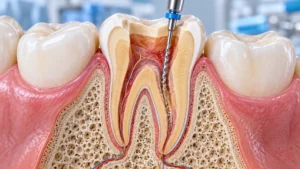
A small opening is created in the upper surface of the tooth to access the pulp chamber.
Infected or damaged tissues inside the chamber are then removed.
The dentist subsequently gains access to the canal system located inside the roots of the tooth.
The number of root canals differs from one tooth to another. Front teeth generally have fewer canals, while molars may contain multiple and more complex canals.
For this reason, root canal treatment on molars may take longer.
How Are Root Canals Cleaned During Treatment?
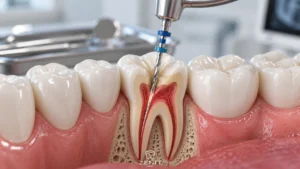
Once the root canals have been accessed, infected tissue is removed using specialized endodontic files.
Removing bacteria and organic debris from inside the canals is extremely important for the success of treatment.
While the canals are mechanically shaped, they are also irrigated using specialized disinfecting solutions.
The purpose of this process is to reduce microorganisms within the root canal system as much as possible.
Cleaning may take longer in teeth with particularly narrow, curved, or complex root canal anatomy.
This can also affect the answer to how many sessions does root canal treatment take.
Is Medication Used During Root Canal Treatment?
In some root canal procedures, antibacterial medication may temporarily be placed inside the canals.
This approach may be preferred in cases involving significant infection, where the dentist decides not to permanently fill the canals immediately.
After medication is placed inside the canals, the tooth is sealed with a temporary filling.
At the next appointment, the temporary filling is removed and the canals are reassessed.
If there are no remaining signs of active infection, the permanent root canal filling may then be completed.
For this reason, when a patient has an advanced infection, the answer to how many sessions does root canal treatment take may involve more than one appointment.
How Is the Root Canal Filling Performed?
After the root canals have been thoroughly cleaned and appropriately shaped, they are sealed using specialized filling materials.
The purpose of the root canal filling is to prevent bacteria from re-entering the canal system.
Creating an effective seal within the root canals is an important part of the treatment.
After the root canals are filled, the upper portion of the tooth may be restored with a dental filling.
If a significant amount of tooth structure has been lost, the dentist may also consider restorative treatments such as a dental crown.
How Long Does One Root Canal Treatment Session Take?
The duration of a single root canal appointment can vary depending on the structure of the tooth and the number of canals.
A root canal session may generally take approximately 30 to 90 minutes.
Treatment may be shorter for a front tooth with a single canal, while molars with multiple root canals can require more time.
If the tooth has previously undergone root canal treatment and requires retreatment, the procedure may also take longer.
Therefore, just as how many sessions does root canal treatment take can vary, the duration of each individual session may also differ from patient to patient.
How Many Days Does Root Canal Treatment Take?
A single-session root canal treatment can often be completed on the same day.
If treatment requires two appointments, there may be several days between sessions, or another interval determined by the dentist.
During this period, the tooth is usually sealed with a temporary filling.
The dentist will determine the most appropriate timing for the second appointment based on the condition of the tooth.
If an infection needs additional time to be brought under control, the interval between appointments may be longer.
Is Root Canal Treatment Painful?
One of the most common concerns about root canal treatment is whether the procedure is painful.
Root canal treatment is generally performed under local anesthesia.
For this reason, patients typically should not feel pain during the procedure.
However, mild sensitivity or discomfort when biting may occur for a few days after treatment.
This may be more noticeable in teeth that had significant infection or inflammation before treatment.
If pain becomes progressively worse instead of improving, or if swelling develops, patients should contact their dentist.
Factors That Affect How Many Root Canal Treatment Sessions Are Needed
The answer to how many sessions does root canal treatment take depends on several factors.
Severity of the Infection
Teeth with significant infection or an abscess around the root tip may require treatment over multiple appointments.
Number of Root Canals
The number of canals within the tooth can directly affect the duration of treatment.
Front teeth generally have fewer canals, while molars may have more complicated root canal systems.
Root Canal Anatomy
Some patients have root canals that are very narrow, curved, or anatomically complex.
These situations may require additional time for cleaning and shaping.
Previous Root Canal Treatment
If a tooth has already undergone root canal treatment and requires retreatment, the existing root filling material may first need to be removed.
This can increase the overall treatment time.
Presence of a Dental Abscess
Some teeth with active infection or an abscess may require treatment in several stages.
Once the infection has been controlled, the root canal filling can be completed.
What Should You Pay Attention to After Root Canal Treatment?
Following your dentist’s recommendations after root canal treatment can help support a smooth recovery.
Patients should be particularly careful when eating before the effects of local anesthesia have completely worn off.
While numbness is still present, it is possible to accidentally bite the tongue or inside of the cheek.
If the tooth has been sealed with a temporary filling, patients may be advised to avoid chewing very hard foods on that side.
Temporary fillings may not be as durable as permanent restorations.
Maintaining good oral hygiene is also important.
Teeth should be brushed regularly, and the spaces between teeth should be cleaned using appropriate interdental cleaning methods.
When Can a Root Canal-Treated Tooth Be Used Normally?
Patients can usually return to their daily routine shortly after root canal treatment.
However, eating may be discouraged until the effects of local anesthesia have completely worn off.
If a temporary filling has been placed, excessively hard or sticky foods may need to be avoided.
Once the permanent filling or other necessary restoration has been completed, the tooth can generally return to normal function.
The individual recommendations provided by your dentist should always take priority.
Why Can a Tooth Hurt After Root Canal Treatment?
During root canal treatment, infected tissue from inside the tooth is removed.
However, the tissues surrounding the tooth root remain alive.
Mechanical procedures performed during root canal treatment may temporarily irritate the tissues around the root.
As a result, mild discomfort may occur when chewing for a few days after treatment.
If pain is severe, becomes progressively worse, or is accompanied by facial swelling, the dentist should be contacted as soon as possible.
Is Root Canal Treatment Successful?
When performed appropriately, root canal treatment can help preserve a natural tooth for many years.
Several factors can contribute to the success of treatment, including:
- Proper cleaning of the root canals
- Effective disinfection of the canals
- Appropriate sealing of the root canal system
- Proper restoration of the upper portion of the tooth
- Good oral hygiene habits
Root canal-treated teeth should also be checked regularly, just like other natural teeth.
What Happens If Root Canal Treatment Is Not Performed?
If a tooth that requires root canal treatment is left untreated, the infection may continue to progress.
The tissues surrounding the root can become affected, and an abscess may eventually develop.
In advanced cases, patients may experience swelling, severe pain, or difficulty chewing.
As the infection progresses, preserving the natural tooth may become more difficult.
For this reason, treatment should not be unnecessarily delayed when root canal therapy is required.
In Which Situations May Root Canal Treatment Be Necessary?
Root canal treatment is not required for every toothache.
However, it may be considered in situations such as:
- Deep tooth decay
- Infection of the dental pulp
- Cracks or fractures in the tooth
- Pulp damage caused by trauma
- Infection around the root tip
- Pulp damage associated with repeated dental procedures
A clinical examination and appropriate imaging are necessary to establish an accurate diagnosis.
Is a Crown Necessary After Root Canal Treatment?
It is not correct to say that every root canal-treated tooth automatically requires a crown.
The need for a crown depends on factors such as how much healthy tooth structure remains, the location of the tooth in the mouth, and the chewing forces placed on it.
For back teeth with significant loss of tooth structure, different restorative options may be considered to help reduce the risk of fracture.
Your dentist will determine the most appropriate restorative treatment after examining the tooth.
How Many Sessions Does Root Canal Treatment Take? Is One Session or Two Sessions Better?
The most important factor is not simply the number of appointments, but whether the treatment is performed according to the needs of the individual tooth.
Some teeth can be successfully treated in one appointment, while others may require several sessions to bring an infection under control.
Therefore, there is no single answer to how many sessions does root canal treatment take that applies to every patient.
Following a clinical examination and appropriate imaging, the dentist can determine whether the treatment should be completed in one session or several sessions.
Frequently Asked Questions About Root Canal Treatment
How many sessions does root canal treatment take?
Root canal treatment can often be completed in one or two sessions. However, the severity of the infection, root canal anatomy, and overall condition of the tooth may require additional appointments.
Can root canal treatment be completed in one day?
Yes. In suitable cases, root canal treatment can be completed on the same day.
Are the nerves removed during root canal treatment?
During treatment, damaged or infected tissues within the pulp chamber and root canals are removed.
Is root canal treatment painful?
Root canal treatment is performed under local anesthesia, so patients generally do not experience pain during the procedure.
Is pain after root canal treatment normal?
Mild sensitivity may occur for a few days after treatment. If pain becomes severe or progressively worsens, you should contact your dentist.
Can root canal treatment be performed on an infected tooth?
Depending on the condition of the tooth, root canal treatment may be performed. In cases involving significant infection, the procedure may need to be completed over several appointments.
Root Canal Treatment at ZenitDent
Early diagnosis, appropriate treatment planning, and regular follow-up appointments are important for preserving natural teeth during root canal treatment.
If you experience persistent toothache, sensitivity to hot or cold, discomfort while chewing, gum swelling, or changes in tooth color, a dental examination may be necessary to determine the underlying cause.
The answer to how many sessions does root canal treatment take can only be determined more accurately after evaluating the tooth structure and the severity of any existing infection.
At ZenitDent, a detailed oral and dental examination can be performed to evaluate suitable treatment options and create an individualized root canal treatment plan.
Conclusion: How Many Sessions Does Root Canal Treatment Take?
In summary, there is no single answer to how many sessions does root canal treatment take. Today, many root canal procedures can be completed in one or two appointments. Yapıştırılan metin
When there is no significant infection and the root canal anatomy is suitable, treatment may be completed in a single session. However, when an infection, abscess, or complex root canal structure is present, treatment may need to be spread across several appointments.
The goal of root canal treatment is not only to relieve pain but also to remove infected tissue and preserve the natural tooth for as long as possible.
Therefore, the quality of diagnosis, effective disinfection of the root canals, proper sealing, and appropriate restoration are more important than the number of treatment sessions.
If you experience persistent tooth pain or signs of infection, you can contact ZenitDent for a detailed dental examination and obtain information about a personalized root canal treatment plan.